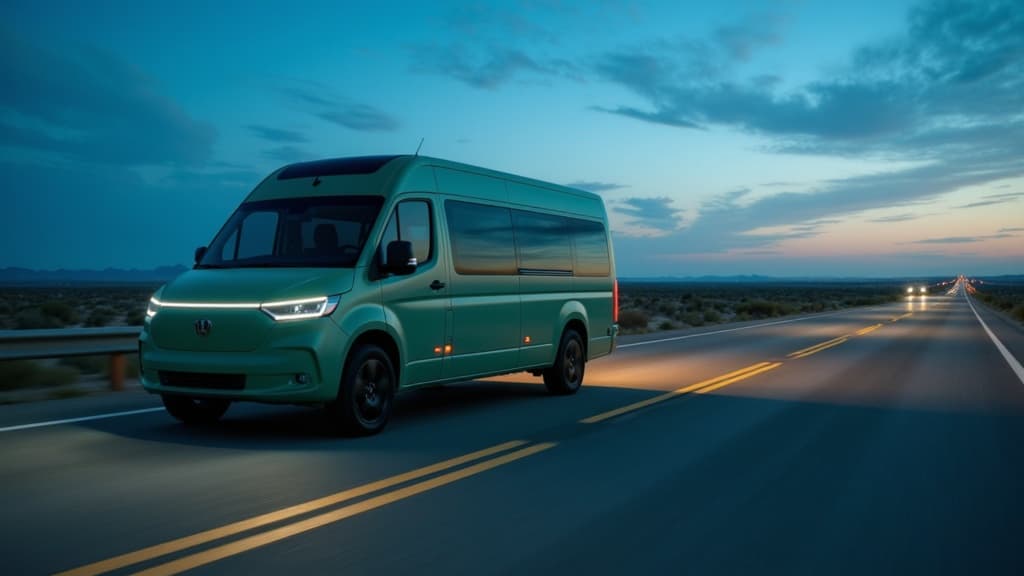
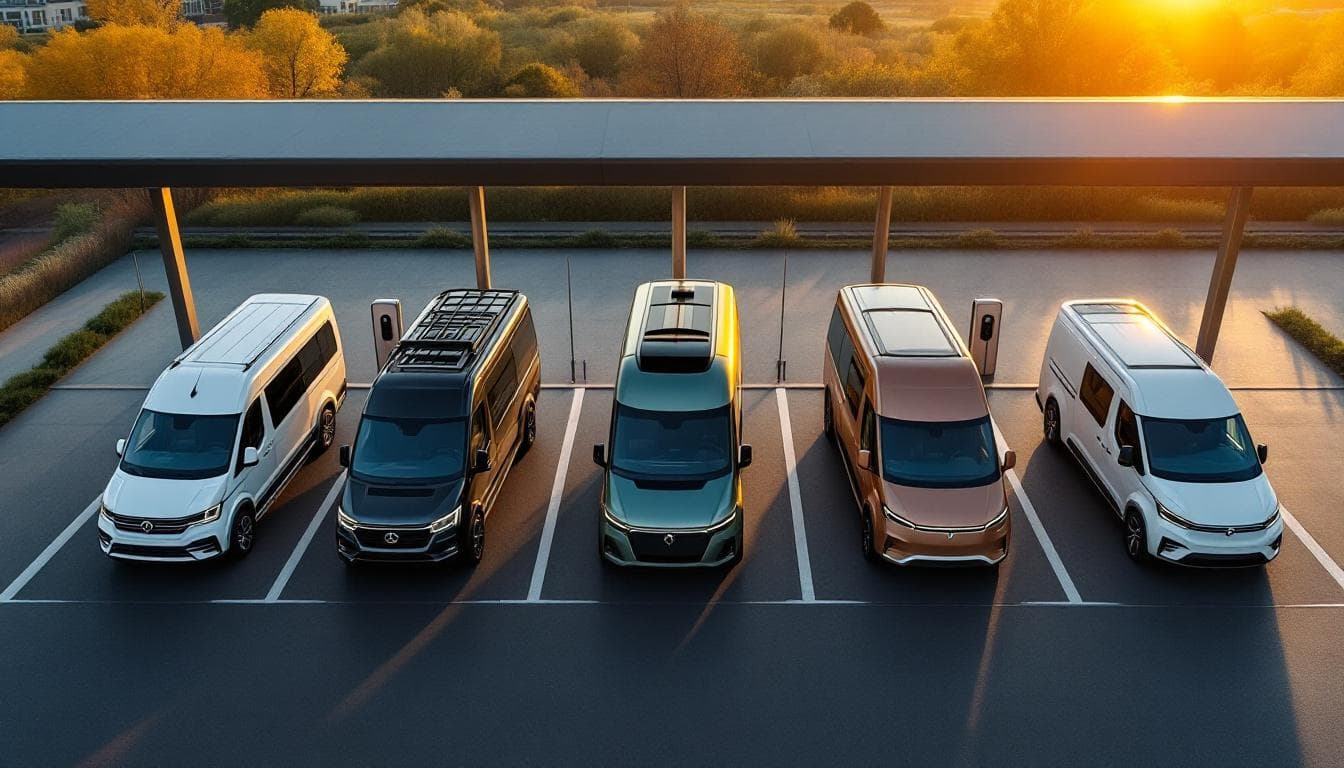
A whitepaper on autonomous mobile living platforms, the convergence of electrification, connectivity, and autonomy, and what it does to housing, labor, and civic life.
Three curves are converging for the first time in history. Electric propulsion, satellite connectivity, and autonomous driving each represent a trillion-dollar trend on its own. Together, they collapse two assumptions that have defined American life since the 1950s: that transit time is dead time, and that dwelling requires a fixed address. This paper argues that the resulting convergence creates a new product category, the mobile living platform, that its economics already work at small scale, will work dramatically at scale once highway autonomy arrives, and will reshape housing, labor, and urbanism through the 2030s. Wayhaven is one answer to what that platform should be.
FIG. 1 / THE CONVERGENCE
I
The Three-Curve Convergence
Trillion-dollar trends rarely arrive together. Electric propulsion, broadband-via-satellite, and autonomous driving have each, over the last fifteen years, moved from speculative to inevitable. Each alone has generated its own industry, its own incumbents, its own regulatory debates. What has not been properly appreciated is that they are about to arrive together, and that their intersection is not additive, it is a new category.
The autonomy curve. Waymo is approaching one million paid rides per week by the end of 2026, with 127 million autonomous miles logged and a 90% reduction in serious-injury crashes versus human-driven baselines across that dataset. Waymo's own public metric is one million weekly rides as the 2026 success threshold. Tesla launched unsupervised paid robotaxi service in Austin in January 2026 and expanded its geofence from 20 to 245 square miles in three months, a twelve-fold expansion. The trajectory is legible. Aurora and Kodiak are running driverless freight at commercial scale on Sun Belt highways today. Level-4 autonomy is not a speculative technology. It is a deployed technology, still being scaled.
The connectivity curve. Starlink passed ten million subscribers in February 2026 and is adding roughly 21,275 new users per day, a faster adoption curve than the iPhone. SpaceX's internal forecasts put Starlink at $20B in 2026 revenue with $14B EBITDA. Starlink Mini weighs 2.5 pounds, costs $249, and the Roam plan supports in-motion use at highway speeds. The geography where 5G is unreliable rural mountain west, national parks, the American outback, is precisely the geography that mobile dwellers want to inhabit. Starlink closes the last gap.
The electrification curve. There are 71,398 public DC fast-charging ports in the United States as of April 2026, growing at more than 1,000 ports per month. Rivian's commercial van outsold the Ford E-Transit and the Mercedes eSprinter combined in 2024, the EV van market has a clear leader, and it is not a legacy OEM. BYD's Blade 2.0 chemistry delivers 1,000+ kilometers of range and 10%-to-70% charge in five minutes. Both BYD and CATL have solid-state cells at 400 Wh/kg in vehicle trials targeting limited production in 2027. A purpose-built EV van at launch in 2028 will ship with more than 200 kWh of battery and enough charge-rate to fully refill during an eight-hour overnight.
Separately, each is a hundred-billion-dollar trend. Together, they collapse a cost structure that has defined American life since the 1950s.
FIG. 2 / INDEXED GROWTH OF THE THREE CURVES, 2018–2026
Three curves, each a decade of compounding progress. The surprise, the thing this paper is about, is what happens when they intersect.
Autonomy by itself gives you a car that drives itself. Useful, but not transformative; the car remains a car. Connectivity by itself gives you the internet in motion. Useful, but a feature, not a category. Electrification by itself gives you a cleaner version of the same vehicle you already own.
But a vehicle that is electric (so its battery is a home power source, not just a fuel tank), always connected (so you can work, call, and stream from anywhere), and autonomous (so you are not required to drive it) is a different object. It is not a car with features. It is a room that moves. And a room that moves, with all the power, bandwidth, and space of a small apartment, is a new kind of dwelling.
This is the Wayhaven thesis: the purpose-built mobile living platform is the product the three curves are creating. It looks superficially like an RV or a van, but that resemblance is cosmetic. Its architecture is closer to a studio apartment with wheels and a software stack. Its unit economics are closer to a SaaS product with a hardware bundle. Its ownership model is closer to a subscription than a purchase.
No existing category correctly describes it. That is always how new categories feel when they arrive.
FIG. 3 / TIME RECLAIMED
II
The Death of Transit Time
The average American loses roughly 10,000 waking hours to driving over a lifetime. That is five years of conscious adult life spent watching the road, hands at ten and two, attention locked to a task that contributes nothing productive, and cannot, because we have deliberately engineered driving to require full human engagement.
When Level-4 autonomy arrives at highway speeds, those 10,000 hours become available for anything else: sleeping, reading, meeting, eating, thinking, watching, exercising, being with people. This is the single largest time-reclamation event since the transition from manual to industrial labor. It is one of the largest human-welfare interventions the economy could deliver.
10,000
HOURS AMERICANS LOSE TO DRIVING / LIFETIME
~5 yrs
EQUIVALENT WAKING ADULT LIFE
18–41%
AV-REDUCED VALUE OF TRAVEL TIME
The usual framing treats L4 as a convenience upgrade, I don't have to drive, as if the vehicle is the same product with a better feature. This is the telephone-to-smartphone mistake. A smartphone is not a telephone with apps. It is a different object that ate a dozen products camera, map, compass, flashlight, calendar, stereo, encyclopedia, newspaper, and redefined what a pocket computer could be.
In the same way, an autonomous mobile platform is not a van with a driver assistant. It is a different object that eats several products, the commuter car, the studio apartment, the airline seat, the coworking space, the hotel room, and redefines what it means to travel.
The road stops being somewhere you go. It becomes somewhere you live.
The value unlock comes from a simple equivalence: a mile of highway, at $0.40 driven by an L4 system, is not a cost, it is a setting. If you can work, rest, or eat during that mile, you are paying $0.40 for a sixty-second change of location. You are not paying for the mile. You are paying to have your office or your bed move.
At 400 miles per day, roughly a half-day of steady L4 driving, you can reconfigure what “home” means every morning. Your kitchen is in Monterey; your afternoon is in Santa Barbara; your evening is in Joshua Tree. You never missed a meeting. You slept eight hours. You cooked dinner. Nothing about your productive day was worse. Most of it was better.
Empirical research on autonomous-vehicle time use supports this framing. A four-region study published in 2025 of projected AV time allocation found that 37.6% of alone trips would be actively used (work, communication, media creation), 19.9% passively used (watching, listening), 23.8% monitoring, and 18.7% refused outright. Separately, economic studies estimate that AV availability reduces the value of travel time by 18-41%. Commuting alone sees a 33% reduction. One academic summary puts it directly: productive use of time is not necessarily tied to work or study; sleeping, relaxing, and gazing out the window are considered good use of time.
Transit time does not just become productive. It stops existing as a separate category of time. And when a category dissolves, an industry does too. The airline no longer competes against the car; it competes against sleep. The hotel no longer competes against home; it competes against doing nothing. The whole landscape of how Americans spend their hours gets rearranged.
What a mobile living platform captures is the moment this rearrangement begins. Not the steady state, that is fifteen years off, but the inflection, when the first meaningful slice of the population starts to live inside the product of the three-curve convergence.
FIG. 4 / WHAT MOBILE LIVING IS A RESPONSE TO
III
Why Now
The temptation is to read the preceding sections as speculative fiction. They are not. The preconditions are in place today, in 2026.
The economic case already works. Full-time vanlife costs between $900 and $3,800 per month, with solos averaging $900-$1,500 once the vehicle is amortized. The data is unambiguous. Median US rent is $1,900 per month. In 40 of 50 US states, a solo vanlife dweller now lives more cheaply than a renterwith infinite mobility included. The mobile apartment is already cheaper than the stationary one. Autonomy does not create the case; autonomy just unlocks the time dimension that makes the case universal.
40 / 50
US STATES WHERE VANLIFE BEATS RENT
$1,900
MEDIAN US MONTHLY RENT
65%
US HOUSEHOLDS PRICED OUT OF MEDIAN HOME
FIG. 5 / MONTHLY HOUSING COST · SOLO DWELLER
The demographic base is enormous and growing. There are roughly 3.1 million vanlife Americans as of 2022, up from 2.6 million the prior year, making it the fastest-growing digital-nomad subtrend of the post-pandemic cohort. There are 18.5 million US digital nomads in 2026, up nearly 4x from 4.8 million in 2018. Global digital nomads total 43 million and are projected to reach 80 million by 2030. Fifty-two percent of the global workforce works remotely in some form; 26% of US knowledge workers are fully remote. Flexibility now outranks salary as the number-one benefit among knowledge workers. A structural shift this large does not reverse on the timelines that matter for our thesis.
The housing case is broken for most people. The median US home price is about $400,000, roughly five years of median household income. Sixty-five percent of US households cannot afford a median-priced new home. 22.7 million renter households are cost-burdened, spending more than 30% of their income on rent, an all-time high. Something has to absorb this pressure. Mobile living is one of the few candidates that is already economically viable for its intended users.
The EV platform is real. Rivian's commercial van outsold the Ford E-Transit and the Mercedes eSprinter combined in 2024. Battery chemistries are in flight: BYD's Blade 2.0 delivers 1,000+ kilometers of range and a 10%-to-70% charge in five minutes. Solid-state cells at 400 Wh/kg are in vehicle trials for 2027 production. There are 71,398 DC fast-charging ports in the US in April 2026, growing at 1,000+ per month. Tesla's Supercharger network alone handled 53 million sessions in Q1 2026, up 26% year-over-year.
FIG. 6 / 2024 US ELECTRIC VAN SALES · THE NEW LEADER IS NOT A LEGACY OEM
Connectivity is here. Starlink has ten million subscribers and is growing at 21,275 per day, a faster curve than the iPhone. The hardware is 2.5 pounds and $249. The Roam plan supports in-motion use up to 100 mph. 5G covers 98% of Americans via T-Mobile. The 30% of US land where cellular is unreliable is precisely the geography vanlifers want to inhabit, and Starlink fills that gap completely.
Autonomy is arriving in stages. Waymo logs four million autonomous miles per week and has served 500,000 paid rides per week, targeting one million by the end of 2026. Waymo's data shows a 90% reduction in serious-injury crashes across 127 million miles. Tesla launched unsupervised paid robotaxi service in Austin in January 2026 and expanded the geofence twelve-fold in three months. But the signal to watch is neither of them, it is autonomous trucking. Aurora and Kodiak are already running driverless freight on Sun Belt highways. When that scales, probably 2027 or 2028, the same L4 stack ports to consumer highway vehicles. The timing is legible: 2028-2030 for highway-only L4 on consumer platforms, 2030-2035 for urban L4 at consumer scale.
The platform must exist before the autonomy arrives, not after.
The window for building a purpose-built mobile living platform is now. The vehicle has to exist before autonomy ships. The company that owns the hardware at the moment highway L4 becomes commercially available gets the category lock-in. Cruise's death, GM wound down the program after its pedestrian-drag incident, is instructive. The category requires purpose-built entrants. Automaker skunkworks fail because they cannot cannibalize the rest of their business. The entrants that win will be the ones that started with a blank page.
FIG. 7 / THE INTEGRATED INTERIOR
IV
The Vehicle as Platform
A mobile living platform is not a van. A van can be a platform. Most vans are not.
The difference is architectural. A conversion inherits the compromises of a vehicle designed for cargo or commuting: wheel wells intrude into the cabin, floors are raised to clear a gas tank, HVAC is tacked on, the electrical system was never meant to power a refrigerator for five days, and the wiring harness cannot accept over-the-air updates. A purpose-built platform starts the other way around. The living systems dictate the vehicle, not the reverse.
Stack the layers:
LAYER 1
Vehicle
Flat floor from firewall to rear. Unified high-voltage architecture. Weight distribution optimized for a 200-kWh pack plus 1,500 lbs of dwelling. NVH engineered for sleep-quality acoustics, not highway use.
LAYER 2
Living systems
Water, waste, HVAC, kitchen, bathroom, security, lighting factory-integrated subsystems sharing the same software plane as the drivetrain.
LAYER 3
Software
The operating system. Energy management partitions the battery between driving reserve and house loads. Trip planning computes L4 handoffs, charging stops, overnight networks, water refills. The mode system reconfigures lighting, climate, audio, seating, and security with one tap.
LAYER 4
Service network
Certified maintenance. Overnight parking partnerships. Mobile service. Integrated insurance. Hardware alone doesn't solve the problem; the network around the hardware does.
LAYER 5
Autonomy
The last layer arrives last. By the time L4 is safe and legal on consumer highways, Layers 1 through 4 must already be in place. Autonomy then turns an existing premium product into the full promise.
The architectural argument is simple. Hardware alone is a commoditizable asset. Software alone has no grounding. The combination, vertically integrated, each layer designed in concert, is the moat. Tesla taught the industry this. Apple taught Tesla. The software-defined vehicle is not about adding more software to vehicles. It is about designing the vehicle as a software object from zero.
Hardware alone is commoditized. Software alone is ungrounded. The combination, designed in concert, is the moat.
The Volvo subscription experience is instructive about what not to do. Care by Volvo died in 2024 because it sold a car subscription. A car subscription is a lease with a marketing rebrand, not a product. Mobile living is a different problem. The customer is not choosing between a Volvo and an Audi; they are choosing between renting an apartment plus owning a car and living in one integrated platform. The product is not the vehicle. The product is the continuous experience of housing plus transit plus workspace plus connectivity. That is what gets sold. That is what gets priced. That is what gets iterated.
Wayhaven is the first entity designing specifically under this constraint. The conversion market cannot get there without starting over. The RV industry cannot get there without rebuilding its supply chain; its shipments fell 11.1% year-over-year in February 2026, while vanlife continues to grow. The OEMs cannot get there without abandoning the dealer-franchise economics that subsidize the rest of their business. The window is an artifact of the incumbent inability to cannibalize itself. It will not stay open forever.
FIG. 8 / SOFTWARE-DEFINED INTERFACE
FIG. 9 / GEOGRAPHIC CLUSTERING
V
First Place on Wheels
Ray Oldenburg's 1989 framework of first, second, and third place described the spatial sociology of mid-twentieth-century American life. The first place was home. The second place was work. The third place, the pub, coffee shop, church, barbershop, library, was the democratic civic commons, where strangers become familiar and a society keeps itself stitched together.
Mobile living upends this arrangement.
For a Wayhaven dweller, the first place and the second place fuse. Home is the vehicle. Work is also the vehicle. The productive and the private collapse into a single 250-square-foot object that follows you. This is not a small shift. The spatial separation between home and work was a load-bearing structure of twentieth-century social life. When it dissolves, the third place does not just become important, it becomes civilizationally necessary.
The academic literature is catching up. A 2025 longitudinal study of digital nomads “Alone on the Road”, identifies loneliness as the number-one mental-health challenge in the population. Nomads report emotional malnutrition despite frequent social contact. Meetup apps and coworking spaces generate shallow connections that can deepen rather than alleviate the problem. This is the hardest unsolved UX problem in mobile living, and no incumbent is seriously trying to solve it.
Home is the vehicle. Work is the vehicle. The third place is where identity stabilizes.
The answer is not more meetup apps. The answer is infrastructure. When home moves, community needs a way to stop being defined by geography and start being defined by membership. The historical precedent is well-established: the Roma, pastoralist societies, military families, populations that have always built belonging around movement rather than fixed location, typically through ritual, network density, and overlapping kinship.
The digital-native version of this infrastructure is buildable. It looks like a few things stacked:
Geographic clustering. Overnight parking networks that intentionally route members within an hour of each other. If three Wayhaven households are near Moab on a Tuesday, the platform tells them.
Ritual. Annual physical gatherings where the dispersed network reconstitutes. Burning Man, but quarterly. SXSW, but for mobile life.
Third-place mediation. Partner spaces, coffee shops, coworking hubs, brewery patios, that recognize members and give them standing. Every Supercharger is already a de-facto forty-five-minute rest stop; the platform turns it into a social node.
Always-on presence. Persistent group chats with ten close friends, available from anywhere, bridging the moments between in-person contact. This is not a substitute for physical co-presence, but it is an asset the Roma never had.
The opposite framing is also worth stating: mobile living may produce better communities than fixed residence, not worse, because it forces intentionality. Strangers in a neighborhood are accidents of real estate. Friends in a dispersed network are deliberately chosen and deliberately maintained. Frequency of physical co-presence may fall, but quality of connection may rise.
This is speculative. It is also exactly the kind of speculation a thought-leadership argument should make, because no one knows the answer yet and someone has to build the apparatus that will produce it.
FIG. 10 / FIRST PLACE
VI
The Ubiquitous Scenario
Suppose the thesis works. Suppose the vehicle ships, autonomy arrives, the economics hold, and a nontrivial fraction of American households switch to mobile living as their primary or partial dwelling. What does 5% adoption look like?
Five percent of US households is roughly six million units.
6M
MOBILE HOUSEHOLDS @ 5% ADOPTION
600 GWh
DISTRIBUTED BATTERY STORAGE
8-12%
MAJOR-METRO RENT DEFLATION
FIG. 11 / MONTHLY COST · TRADITIONAL DWELLING vs WAYHAVEN PLATFORM
At that scale, a mobile living fleet becomes a first-order participant in several national systems at once.
The grid. Six million EVs, each with a 100-kWh average pack, amount to 600 GWh of distributed storage, a larger asset than the entire US stationary battery fleet as of 2025. Peak charging demand of roughly 15 GW is absorbable within the current 25-GW-per-year capacity growth, provided charging is distributed temporally and spatially through smart-charge coordination. Enrolled in V2G (vehicle-to-grid) schemes, the fleet becomes net positive: a parked Wayhaven with a full 200-kWh battery is a peak-shaving asset for the local utility, and the owner receives revenue for lending storage while they sleep.
Housing. If 5% of demand exits the fixed-housing market, roughly 1.3 million units free up. Back-of-envelope, this is enough to reduce average rent in major metros by 8-12%. The largest asset class in the US economy experiences pricing pressure for the first time in fifty years. Homebuilders shift toward premium and family-size inventory rather than entry-level one-bedrooms. The political economy of housing, permitting, zoning, NIMBYism, shifts as a growing constituency of mobile households no longer requires their neighborhoods to restrict new construction.
Labor. Remote-first becomes mobile-first. Employers who already hire across time zones begin to hire across geographies more aggressively. Compensation shifts from location-adjusted to output-adjusted, because location stops being meaningful. Mobile living stipends emerge as a benefit, the way commuter benefits did in the 1990s. Expect company-sponsored fleets: Amazon has already done this with Rivian for delivery drivers; the next step is Amazon for knowledge-worker employees who want to live on the road.
Taxation and residency. South Dakota, Texas, and Florida have built the legal scaffolding for mobile residency. At 5% adoption, these mobile-friendly states compete for the category by offering lower taxes, smoother registration, and digital residency services. Less mobile-friendly states see tax-base erosion. Expect a coalition of states to push for federal “mobile residency” classification, a digital ID that severs residency from physical address.
Infrastructure. Parking, waste, and water management adapt. Cities that have already eliminated parking minimums, Chicago, Washington, Montana, Illinois, find themselves with convertible capacity: lots that were mandated for stationary cars become available for dwelling vehicles. Graywater dump networks, currently a vanlife hack, standardize into public infrastructure the same way EV chargers went from quirky to essential in a decade.
Community. New forms emerge. Place-based identity gives way to membership-based identity. Universities, religions, and professional guilds have always operated this way, but it is new at this scale for domestic life. The question is what civic participation looks like when voters are not constrained to a single legislative district.
Environment. The electric mobile platform with solar and a tight thermal envelope is, on a per-household basis, one of the lowest-carbon dwellings available in the US. An EPA-informed study found RV and van dwelling cut household carbon footprint by 50-66% versus a typical US household, though the finding is predicated on minimizing driving. An electric platform with solar neutralizes the driving penalty entirely. At 5% adoption, the category would be running the largest voluntary decarbonization program in US housing history.
Each of these effects is speculative in magnitude and certain in direction. If mobile living scales, these changes happen. The open questions are how fast, how big, and who captures the value.
FIG. 12 / DEPENDENCIES
VII
The Hard Questions
A paper that does not name its open problems is marketing. Here are the hard ones.
Liability under autonomy. When an L4 vehicle crashes while the occupant is sleeping, who is liable? The current best answer from the insurance industry is “product liability when the automated driving system is engaged.” But the allocation between manufacturer, software vendor, owner, and regulator remains unsettled. NHTSA's 2025 AV STEP rulemaking is voluntary. This means the first serious crash in an unsupervised consumer vehicle will be a case study in real time, and the outcome will either unlock or stall the category by years. Wayhaven's posture is to build for the most conservative liability interpretation, because the most conservative interpretation will be the first that survives court.
Grid capacity. Mass EV adoption requires roughly 80 GW of new generation capacity per year through 2045, about twice the current pace. Mobile living amplifies this only slightly in absolute terms, but it changes the geography of demand, concentrating load at charging corridors rather than at fixed homes. Peak-load management via smart charging and V2G is the linchpin. The operators who do this well are net positive for the grid. The operators who do this badly are net negative. There is no neutral case.
Class politics. Cities currently criminalize homeless vehicle dwelling while tolerating luxury mobile living. Los Angeles' vehicle-dwelling ordinance (LAMC 85.02) expired in July 2025, ending municipal enforcement of the broadest law of its kind. California's AB 2525 lets cities lease Caltrans land for $1 per month to store RVs formerly used as dwellings, a progressive tool that is being used, in practice, to remove unsheltered RV dwellers. This bifurcation is politically fragile. A premium category that visibly depends on the same infrastructure used to house the unsheltered creates a politics of contested use. Mitigation requires pairing the premium offering with genuine public infrastructure investment, or accepting that mobile living becomes a marker of class privilege in a way that invites backlash.
Loneliness. Covered above, but worth restating as an open problem. No vehicle can solve it. Only infrastructure, geographic, ritual, digital, can. Building that infrastructure is as important to Wayhaven's success as shipping the hardware.
The digital postal address. USPS delivery, banking, state IDs, voter registration, and jury duty all assume a fixed address. Current hacks (virtual mailboxes in South Dakota) work but are clunky and state-specific. A federal framework for a digital primary address would legitimize the lifestyle. The political coalition, Wayhaven plus Turo plus Outdoorsy plus RVIA plus progressive zoning-reform allies, does not yet exist but is assembleable.
Starlink dependency. The in-motion connectivity layer is currently Starlink-dependent, and Starlink's pricing and policy has changed repeatedly in short windows (including an in-motion policy shift in March 2026). Long-term resilience requires multi-source connectivity: Starlink plus dual-carrier cellular plus Wi-Fi mesh plus edge-computed offline-first software. Building on a single satellite provider, however good, is a strategic vulnerability.
Stranding risk. What happens to municipal tax bases when 5% of the population leaves fixed housing? Some cities have modeled this under remote-work scenarios and concluded the bases will adapt. Others have not. The fiscal transition is not fatal, but it is not free, and the cities that handle it worst will be tempted to regulate the category away.
These are the questions Wayhaven is not trying to dodge. A thesis that ignores them is a pitch deck. A thesis that engages them, even incompletely, is a position.
FIG. 13 / DWELLING NETWORK · CHARGING CORRIDOR
FIG. 14 / 2030–2040
VIII
The Decade Ahead
A few concrete predictions follow from the data.
FIG. 15 / US MOBILE-LIVING PLATFORM FLEET · PROJECTED 2026–2040
2030
The inflection.
Consumer L4 highway driving is commercially available on premium vehicles. Solid-state batteries deliver 400 Wh/kg and 500+ miles of range as standard on new EV vans. Starlink's third-generation constellation has 40M+ subscribers and delivers 1 Gbps in-motion bandwidth as standard. The purpose-built mobile-living platform category has a US fleet in the low hundreds of thousands, with a category TAM of $5-10B annually. One or two companies have clear leadership. Early adopters are overwhelmingly professional knowledge workers and pre-retiree couples.
2035
Category maturity.
L4 autonomy covers 80%+ of US interstate miles and is available in geofenced form in all top-50 metros. Five to ten percent of knowledge workers, three to six million households, live mobile full-time or part-time. The category TAM is $30-50B annually. A stable competitive landscape: Wayhaven, a Mercedes or Rivian offshoot, a Tesla-native product, possibly an Apple-adjacent entrant that treats the vehicle as the successor to its computing platform. Housing prices in tier-one metros are materially lower than the 2025 counterfactual would have suggested.
2040
Integration.
Mobile living is indistinguishable from “post-physical” housing in status terms. Municipal charging and dwelling networks are standardized civil infrastructure, like roads or sewers. A federal digital-residency framework is in place. Digital-native neighborhoods, persistent communities defined by membership rather than geography, have become a normal form of American civic life. Ten percent or more of housing demand has structurally exited the fixed dwelling market. The downstream consequences, pricing, politics, civic participation, are still being absorbed.
These are not predictions in the strict sense. They are extrapolations from trendlines that, taken together, imply a state. The trendlines could break: regulatory action, grid failure, autonomy setback, economic contraction. But the central tendency of the data points at this state, and the question for any operator in the category is not whether to believe it but at what pace to build for it.
FIG. 16 / THE WINDOW IS NOW
IX
The Case for Building Now
Every trillion-dollar category has had a moment when the technology was obviously going to work and the product was not yet built. Personal computing in 1975. The internet in 1993. Smartphones in 2005. Electric vehicles in 2010. Autonomous driving in 2020.
The moment for autonomous mobile living is 2026-2028. The vehicle must exist before the autonomy arrives, not after. The company that owns the hardware at the moment L4 ships on highways gets the category lock-in. The company that enters after autonomy ships will find the physical supply chain, the service network, the permits, and the brand already taken. This is an eighteen-to-thirty-month build-ahead window, and it closes.
Wayhaven is one answer. It is not the only answer. The category has room for three to five entrants. But the argument of this paper is that the category itself is the right bet, irrespective of which operator wins. Mobile living is not a niche, an RV trend, or a vanlife fad. It is the first serious reorganization of dwelling in a generation, and it rides the biggest tailwinds in the world.
Five years of your waking life are waiting to be handed back to you. The question is what you will do with them.
If you are building a house, you should read this paper and consider whether to build that house. If you are running a city, you should read this paper and think about your parking code. If you are funding the next decade of consumer hardware, you should read this paper and find the five companies trying to build here, because one of them will matter in ten years.
The road stops being somewhere you go. It becomes somewhere you live. Five years of your waking life are waiting to be handed back to you. This paper is one argument about what to do with them.
This paper is a living document. All statistics are drawn from primary or tertiary sources accessible as of April 2026. Citations link to source materials. Wayhaven welcomes correspondence and critique at sean.florez@colorado.edu.